Tag Archives: habits

Peace {2025 Focus}

25 Jan

Last year, my word was Cultivate. Similar to 2023 when I chose Thirst as my word of the year, my desires and inspiration for Cultivate were only partially met over the course of the year.

We had some house projects planned for last year, but we didn’t get to all of them. We patched and repainted our staircase (to get rid of dings and scrapes from the kids). We added a backsplash to the kitchen (and it took us waaaay longer to decide on the tile than I ever thought it would), and repainted the walls in there (deciding on the colors for the walls also took waaaay longer than I thought it would). But we didn’t finish repainting the upstairs, or work on our outdoor firepit patio at all.

As for my personal habits (daily quiet time, exercise, and water intake), those remained unmet. Y’all, the season of young kids is HAAAAARRRRRD. We were majorly spoiled by our third child — our son, Corbin — who loved sleeping, and actually preferred to sleep on his own. Our fourth, Neola, has been the complete opposite. She wanted to be held for naps when she was a baby, wanted to me to sleep in her bed (and she nursed during the night) until she was 2.5, and even now, when she’s 3.5, I more often than not end up in her bed sometime between 1 and 4 a.m.

Neola is also in the stage of what I like to call naptime purgatory, where she needs a nap, but she doesn’t need a nap. She fights going down for a nap, and when she does actually take one, she doesn’t want to go to bed until 10 pm, but if she doesn’t take a nap, she’s a mess and falls asleep in a chair at 5 p.m. without eating any dinner. Ugh!

On top of that, my husband had an extremely stressful job in 2023. He started at a new job in April 2024, and while the job change involved a pay cut, he is no longer stressed out beyond belief, and has a lot more flexibility, which has led to a MUCH better work/life balance. Having a fourth child in 2021 and homeschooling, with a husband who worked a lot and was always stressed, led to both of us feeling behind on 1,000 things, and we are still digging out of that, but every day is better than the one before. This past Friday, I woke up feeling absolutely exhausted and couldn’t shake out of the fog for the first half of the day, and my husband pointed out how far we’ve come, because I used to wake up feeling like that a lot, he said.

All that to say, I still have the same personal goals as years past. Specifically, spending at least 15 minutes in quiet time with God a day, 20 minutes outside (during winter), 30 minutes of quality time with my kids, exercising for at least 20 minutes 3 times a week, and drinking at least 64 oz of water a day. So far this year, some days it has been surprisingly easy to get all that in, some days it has been frustratingly hard, but the majority of days, I do most, but not all of those things. It’s like I have spots for 4 things, but not all 5, and if I make room for one thing, another gets pushed off.

Which leads me to my word for this year: PEACE. When striving for personal goals, I seem to have two extremes: demanding my needs get met at others’ expense, or giving up and not having goals. It takes so. much. faith. in God to be intentional with open hands! To pursue goals but also be gracious when life happens. It ultimately comes down to, do I trust God to provide for and sustain me? Or do I seize control through these things to provide for myself? If my goal and focus was PEACE and not checking off my list, my personal goals would not be ends in themselves, but the means of helping me live peacefully.

I also have to be honest here and say that while my household runs fairly smoothly with routine and chores, it is often the opposite of peaceful. And a lot of that has to do with me and my attitude. I often feel angry and bitter over the lack of control I have over my own schedule (leading to the lack of fulfilled personal goals). I get mad at interruptions during homeschooling, I react impulsively during tantrums or fights while I’m doing chores or making meals, I say words I regret when my kids demonstrate impatience or ingratitude. Sometimes I feel like my household is a whitewashed tomb — having the appearance of godliness, but denying its power.

A few sayings and verses that inspired me to choose PEACE as my word for this year:

  • The goal is peace, not perfection.
  • Gratitude turns what we have into enough.
  • “You keep him in perfect peace whose mind is stayed on you, because he trusts in you” (Isaiah 26:3).
  • “Any problem that comes between God and myself is the result of disobedience. Any problem that comes while I obey God (and there will be many), increases my overjoyed delight, because I know that my Father knows and cares, and I can watch and anticipate how He will unravel my problems” (Oswald Chambers, My Utmost for His Highest, Dec 14).

I want to prioritize PEACE and not perfection. Peace, not a perfectly done homeschool day. Peace, not a perfectly tidied or cleaned house. Peace, not a perfectly followed schedule or routine. I can trust in God’s timing and in God’s provision. I can faithfully pursue physical, spiritual, mental, and relational health, knowing that ultimately, my greatest need is God Himself, and He will prove Himself faithful.

“He who has called you is faithful; He will surely do it” (1 Thessalonians 5:24).
My Habit of Cleaning for 5 Minutes Every Day

29 Apr

IMG_4035Like I mentioned in my last post, I stumbled across a book at the library called “Better than Before: What I Learned About Making and Breaking Habits” by Gretchen Rubin. I grabbed it because building better habits has been a desire of mine for a while, and the book delivered!

The three main nuggets I took away from the book were:

1. It’s easiest to create a new habit by tacking it onto an already-existing habit.

The author, Gretchen Rubin, used existing habits in her own life (brushing her teeth at night, eating breakfast, going to work) as cues for the new habits she was trying to adopt. Her goal was always to get to the point where she could do the habit without thinking–because that’s the definition of a habit. You want it to become so routine that you don’t even think twice about whether or not you do it; instead, you do it because x comes after y all the time.

2. The habit of the habit is more important than the habit itself.

Because the goal is for your habit to become something you do without even thinking, there can be no excuses for not doing it. No “Well I had a late night” or “I’ll do it tomorrow” or my favorite (and most often-used) “I just don’t feel like it right now.” The new habit you’re trying to create might be doing a particular something once a week, or three times a week, or every day, but whatever interval you decide said activity should be done, you must keep to that interval. Even if you’re phoning it in, a half-hearted effort is better for habit-keeping than no effort at all.

However, Rubin recognizes that there are days or weeks when your habit might not be appealing/practical or you’re out of your usual routine (like if your habit is exercise but you have the flu or are on vacation). In those instances, she says (1) Anything is better than nothing. If you’re sick and can’t work out, at least do something fitness-related during the time you would’ve spend working out so that you’re not completely getting off course. (2) If you’re going to be out of your usual routine, it would be better to decide ahead of time that you’re going to take a break from your habits, than to half-heartedly attempt to keep your habits up, only to fail miserably. Think about anytime you tried to bring homework on vacation. Did it ever get touched? I’m guessing no.

3. You have to create habits that fit with your personality.

This is the one aspect of creating and keeping habits that has always tripped me up. One area I’ve frequently tried to get better at is cleaning my house on a regular basis. Every so often, I would be inspired by someone who loved cleaning to adopt their overly ambitious Monthly Cleaning Schedule–or to at least create one of my own that was a little more manageable for my I Hate Cleaning personality.

Everything would go well for about a week. My house would be clean, I’d be motivated, and things were looking up. Then that second week, without fail, I’d give up on that plan whenever Bathroom day came along. (I really dislike cleaning bathrooms.)

Was I just doomed to the monthly cycle of letting my house get filthy and then binge cleaning? Was I just a person incapable of establishing any semblance of routine?

Rubin’s book helped me realize that I am a spontaneous person and almost all of my (non-parenting) decisions each day are based on “What I Feel Like Doing.” So then, if I wanted to establish a habit of cleaning my house, I had to devise a habit that would incorporate my spontaneity, instead of work against it.


Which leads me to:

My Habit of Cleaning for 5 Minutes Every Day

After reading Rubin’s book, I decided to make my goal stupid easy, because if I made it harder, it would never get off the ground with my habit-resistant personality. So my habit would be FIVE minutes of cleaning ANYTHING I felt like cleaning. No schedule, no rules, other than I had to clean for five minutes, every single day.

Out of that decision evolved our current morning routine. We had been in a funk where I’d let the girls watch iPad/phone while I drank a cup of coffee when we got up, but starting the day out on that slothful note gave our whole day a slothful feel. As I started to clean for five minutes in the morning, I realized that my cleaning time would be a great time for the girls to watch iPad/phone, so I started having them eat breakfast and get dressed first thing in the morning. They were more motivated for those things because of the reward of technology afterward, and we started our day out on the right foot.

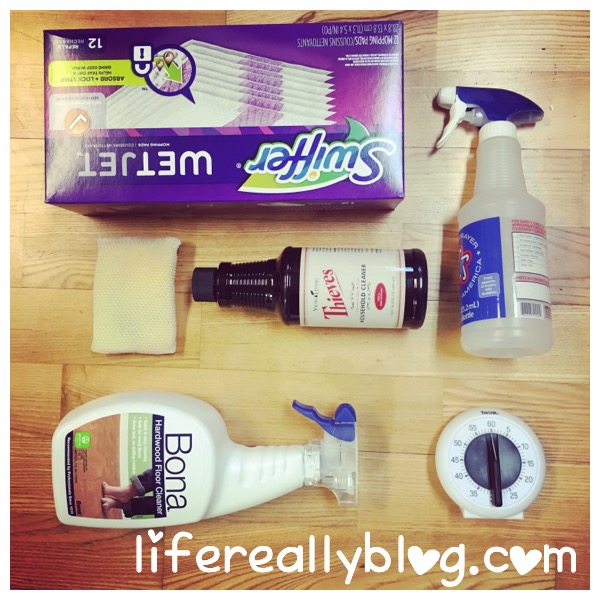
While the girls were watching shows, I’d unload the clean dishes from the dishwasher, load the dirty breakfast dishes, wipe down the counters, and clean for five minutes. I always set a timer. Some days, I don’t feel like cleaning so I choose something super easy (like wiping down the toaster or our stainless steel garbage can), set the timer for 5 minutes, and am down the moment that buzzer goes off. Other days, I work until the buzzer goes off, and then finish the task I’m on. On the rare days I feel motivated or Hubs is watching the kids, I spend 15-45 minutes cleaning (like mopping the floors–can’t do that in five minutes). But I am happy to say that most cleaning chores can be accomplished in 5-10 minutes, even if it means breaking them down into smaller parts (for example, cleaning the bathroom sink and toilet one day, cleaning the tub the next).

The result of this has been two-fold:

My house is cleaner on a more regular basis.

Is everything clean all the time? Nope. But it’s cleaner than it was before AND cleaning no longer stresses me out. Best part? I don’t dread cleaning bathrooms anymore! Because I know that when that 5-minute timer goes off, I can be done cleaning if I want–no guilt.

My daily routine has taken shape.

For a loooong time, I have wanted a more consistent daily routine but was at a complete loss for how to create one that would allow for my spontaneous personality. As I started being consistent with this simple morning routine, I had insight and felt empowered to be more consistent with the rest of our day. I limit the girls’ technology time more, I don’t squander time on Facebook or Instagram as much, and I’m no longer trying to clean during naptime or while the girls are destroying things in another part of the house (seriously, iPad/phone time is the only thing that will immobilize them).

Since my personality is still powered a lot by what I “feel like doing,” I haven’t been 100% consistent with this routine. BUT regardless if I skip a day, I just get back on it the next day, or I find five minutes later in my day to clean. Remember, “the habit of the habit is more important than the habit itself!”

Do I think this routine would work for anyone? Yes and no.

Yes, I think that it’s simple enough anyone could put it into practice. I’m guessing that most people eat breakfast, and probably have an extra 5 minutes to clean something quickly.

No, this isn’t the only way to establish a habit of cleaning more consistently, or of starting your day out. Routines and habits are as plentiful as people, and as I learned reading Rubin’s book, you have to make sure your habits suit you, your personality, and your lifestyle in order for them to last the test of time.

Hope you enjoyed this window into my world! If you want to stay more up-to-date than just my limited blog posts, follow me on Instagram.